Guide to Ohio Marriage Records
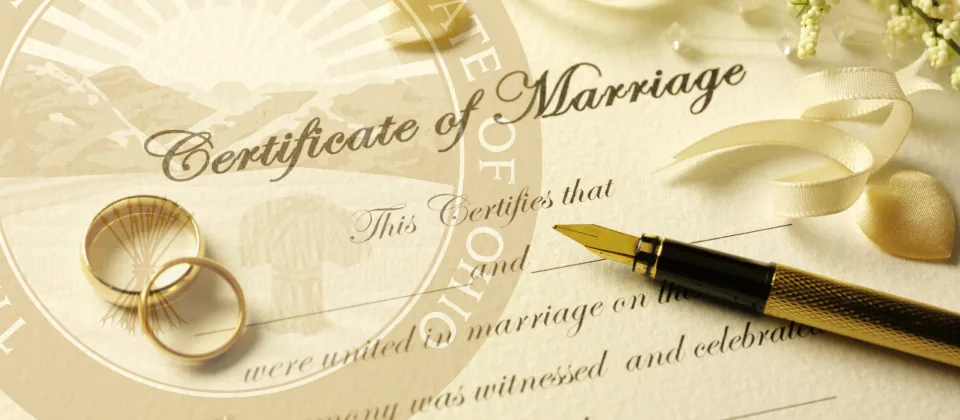
Marriage records are official documents relating to a couple's marriage license and completed marriage. These documents generally contain the spouses' names, the marriage date, the county, license information, and details about the marriage officiant.
Marriage records in Ohio may be a marriage license or a marriage certificate. A marriage license is the document that authorizes the couple to marry. The marriage certificate is the document that states that a marriage ceremony occurred between the two people. Under Section 3101.13 of the Ohio Revised Code, probate courts maintain marriage records and receive completed marriage certificates from officiants.
People search Ohio marriage records for different purposes, including:
- Legal purposes: Proving marital status for Social Security, immigration, insurance, or benefits claims.
- Genealogy and family history: Tracing ancestors and building family trees.
- Name changes: Updating a driver's license, passport, or Social Security card after marriage.
- Divorce or estate matters: Establishing the date and validity of a marriage in court or probate proceedings.
Types of Marriage Records in Ohio
| Record Type | Purpose | Issued By | Validity / Notes |
|---|---|---|---|
| Marriage License | Official authorization to marry | County probate court | Valid for 60 days |
| Marriage Certificate | Official proof of the occurrence of the marriage | Probate court in the county where the marriage license was issued | Required for legal name changes & official claims. |
| Genealogical Marriage Records | Researching family history | Ohio History Connection Archives & Library and county probate courts | Historical coverage varies by county and period. |
Ohio marriage records fall into the following main categories:
Marriage Certificates
A marriage certificate confirms that a marriage ceremony was completed.
It generally contains:
- Names of the spouses
- Marriage date
- Marriage location
- Officiant information
- License or record number
A certified copy may be required when official proof of marriage is needed for matters such as name changes, benefits, immigration, or estate administration. Certified marriage records are issued by the probate court in the county where the marriage license was issued.
Marriage Licenses
The marriage license is the permit that allows a couple to legally marry in Ohio. Note that marriage licenses and marriage certificates are two different documents. A marriage license is issued before the marriage, while the marriage certificate is evidence that the marriage ceremony occurred.
Ohio marriage licenses are obtained from the probate court in the county where a couple intends to marry. Under Section 3101.05 of the Ohio Revised Code, marriage licenses in Ohio are valid for 60 days.
Are Marriage Records Public in Ohio?
Under Section 149.43 of the Ohio Revised Code, marriage records in the state are generally considered public records. Hence, anyone can request a copy of a marriage record by providing identifying details, such as the spouses' names and the approximate date and county of the marriage.
However, restrictions apply to sensitive data within the record. For instance, details such as Social Security numbers are released only to the individuals named on the record or to other authorized parties.
What Information Is Included in a Marriage Record?

An Ohio marriage record typically includes:
- Full names of the spouses
- Marriage date
- Marriage location
- County where the license was issued
- Marriage license number
- Officiant information
Depending on the era and county, marriage records may also include:
- Ages
- Residences
- Places of birth
- Occupations
- Parents’ names
- Previous-marriage information
How to Find Marriage Records in Ohio
Step 1: Identify the Marriage Details
The first step in finding a marriage record is to identify key details, such as the full names of both spouses, the approximate date of marriage, and the county or city where the marriage took place.
Step 2: Find the Record Custodian
Marriage records in the Buckeye State are primarily maintained by county probate courts. However, older records may be available from county archives, records centers, or the Ohio History Connection Archives and Library.
Step 3: Choose How to Search
You may choose your search method from the following options: online, by mail, or in person. Some Ohio counties partnered with VitalChek, a third-party service that allows applicants to obtain marriage records online.
Step 4: Submit a Record Request
When submitting a request for marriage records, you will need to provide the names of both spouses, the approximate marriage date, the completed application, identification, and the applicable fee.
Note that certified copies of Ohio marriage records are official copies issued by the probate court, while uncertified records or online search results are generally used for informational purposes.
How to Get a Certified Marriage Certificate in Ohio
Certified copies of Ohio marriage certificates are not issued at the state level but by the probate courts that issued the corresponding marriage licenses. Since marriage records are generally public, certified copies are not limited to spouses, but the application process may differ slightly from county to county.
Typically, certified marriage certificate applications in Ohio require applicants to submit government-issued photo IDs and processing fees. This is in addition to a completed county request form (where required). The processing fee varies by county (typically between $2 and $5 per copy). For instance, the Franklin County Probate Court charges $2 per certified copy.
Certified copies may be picked up the same day for in-person requests, but mail requests typically take 3 business days to 2 weeks, depending on the volume of requests before the probate court.
Certified copies of Ohio marriage certificates may be used as official proof of marriage for name changes, benefits, immigration, estate matters, and other official purposes.
How to Get a Marriage License in Ohio
In Ohio, individuals seeking a marriage license must apply to a probate court in the same county where either or both applicants reside. For couples from outside of Ohio, the application for a marriage license must be submitted in the county where the ceremony will be performed.
Both applicants must be aged 18 or older to be eligible for a marriage license. However, in accordance with Chapter 3101 of the Revised Code of Ohio, individuals aged 17 may marry with approval from a juvenile court. This is also accompanied by a mandatory 14-day waiting period.
Another requirement for persons applying for an Ohio marriage license is that they provide valid government-issued identification during the application process. In addition, if either applicant was previously married, they must submit documentation verifying how the previous marriage ended.
The fee for the marriage license ranges from $30 to $75, depending on the county. There is no general waiting time for the issuance of the marriage license, other than the 14-day waiting period applicable to minors.
An Ohio marriage license is valid for 60 days after its issuance. Marriages in the state must be solemnized by authorized individuals, such as a licensed member of the clergy, a judge, a mayor, or another official registered with the Ohio Secretary of State. After the ceremony, the completed marriage license must be returned to the appropriate probate court, typically within 30 days.
Who Can Request Marriage Records?
Ohio marriage records may generally be requested or inspected by:
- Spouses
- Immediate family members
- Authorized representatives
- Government agencies
- Attorneys
- Genealogists
- Researchers
- Other third parties
Free and Online Marriage Record Searches

Confirming that a marriage record exists and viewing basic index information for that record are typically free. However, you cannot obtain a certified copy bearing a court seal (required for legal purposes) from free online search portals.
Some county probate courts, such as those in Franklin and Hamilton counties, provide free online searches. These portals may provide access to spouses' names, marriage date, license date, and record number.
Historical Ohio marriage records may be available through the Ohio History Connection Archives and Library and FamilySearch.com.
If the county of marriage is unknown when performing an Ohio marriage record search, requesters can search for the couple’s names in nearby U.S. Federal Census records. Census records from before and after the estimated marriage year may help identify where the couple lived. Afterward, they may search the Ancestry Ohio Marriage Index (requires a subscription) to pinpoint the correct county for post-1950 marriages.
Common Law Marriage in Ohio
Ohio does not recognize common-law marriages formed in the state on or after October 10, 1991. However, common-law marriages lawfully established in other jurisdictions may be recognized in the Buckeye State. Since a common-law marriage was never licensed or certified, there is generally no marriage certificate or license on file with a probate court.
How to Correct an Error on a Marriage Record
Typographical errors in name spelling, incorrect birth dates, or incorrect parental details are common errors found in Ohio marriage records. The state permits either spouse listed on the record to request an amendment to a marriage record. An authorized legal representative of either spouse is also permitted to request a change in the record if the spouse is deceased.
To correct an error on an Ohio marriage record, the requester must submit a completed application (provided by the county probate court) for correction or amendment to the specific county probate court that initially issued the marriage license.
Depending on the type of correction needed, the required evidence includes certified copies of birth certificates, passports showing the correct spelling or date, affidavits, and court records.
Fees and processing times for this request vary by county. Processing can take a few days to several weeks, depending on whether a judge's review is required.
Marriage Records and Name Changes
A certified marriage certificate is the standard legal document used for a name change after marriage. This document may be requested by different government agencies, including:
- The Social Security Administration
- The Ohio Bureau of Motor Vehicles
- The U.S. Department of State
- Banks, employers, and insurance providers
However, getting married and having a certified copy of a marriage certificate does not automatically update a name on file with the government or official agencies. An individual must separately request the change with each agency, presenting the certified marriage certificate as proof.
Similarly, requesting a correction to an error in a marriage record is a different process from a name change. A correction fixes a mistake made at the time of filing, while a name change reflects a new legal name adopted by the applicant as a result of a marriage.
Marriage Records for Genealogy and Family History
County probate courts in Ohio have maintained marriage records since the 1700s. This allows genealogical and family history researchers to have access to older marriage records. Note that marriage entries in Ohio written before 1899 rarely include the names of the couple's parents.
Marriage research archives available to genealogical researchers include:
- Ohio History Connection: Located in Columbus, this state archive holds expansive microfilm logs and print indexes of early frontier marriages,
- County Record Centers: Several local jurisdictions maintain specialized historical archive rooms, separate from the modern courthouse, to store volume ledgers dating to the 1800s.
Digitized indexes and images of historical marriage records from many Ohio counties are available on FamilySearch.com (free) and Ancestry.com (subscription).
Using these search platforms, researchers can search by spouse's name, county, and approximate marriage date. Note that older records may be incomplete, unavailable online, or contain spelling and indexing variations.
Frequently Asked Questions
Are marriage records public in Ohio?
Yes. Marriage records are typically classified as public records according to Section 3101.051 of the Ohio Revised Code. However, certain information, including Social Security numbers, is restricted.
How can I find a marriage record by name?
You can search the probate court docket for the county that provided the marriage license by using either or both of the spouses' names, as well as the approximate date if known.
Can I search marriage records online for free?
Yes. A few counties in Ohio allow free access to probate court marriage records online. Some online search portals, such as FamilySearch, also allow free searches for older marriage records.
How much does a marriage certificate cost?
Your fee for a marriage license can vary by county. However, typical charges range between $2 and $5 per certified copy. Requests completed via the approved third-party vendor generally cost more, including a service charge.
How long does it take to get a certified marriage certificate?
Completion time can vary by county depending on the method used to confirm the request. In-person requests at the probate court are typically processed on the same day. Mail or online requests usually take a few days to a few weeks.
Can someone else request my marriage certificate?
Since marriage records are generally public, anyone can access your marriage certificate; however, certain information, such as your Social Security number, is restricted from public disclosure.
What is the difference between a marriage license and certificate?
A marriage license is basically permission to get married, while a marriage certificate signifies that a marriage ceremony was conducted.
Table of Contents
- Types of Marriage Records in Ohio
- Are Marriage Records Public in Ohio?
- What Information Is Included in a Marriage Record?
- How to Find Marriage Records in Ohio
- How to Get a Certified Marriage Certificate in Ohio
- How to Get a Marriage License in Ohio
- Who Can Request Marriage Records?
- Free and Online Marriage Record Searches
- Common Law Marriage in Ohio
- How to Correct an Error on a Marriage Record
- Marriage Records and Name Changes
- Marriage Records for Genealogy and Family History
- Frequently Asked Questions